
T is for Task
TBLT, one letter at a time

Ask most language teachers if they use tasks in their classrooms, and the answer is almost always yes.
And they’re probably right … at least in the loosest sense of the word. They give learners things to do. Activities with instructions, a time limit, something to produce at the end. In everyday English, all of that counts as a task.
But in task-based language teaching, the word carries more weight than that. And the gap between the everyday meaning and the technical one is, I’d argue, one of the main reasons so many teachers feel they’re doing TBLT when something rather different is actually happening in their classrooms.
So what is a task, exactly?
Willis (1996) describes tasks as activities where the target language is used by the learner for a communicative purpose in order to achieve an outcome.
Long (2015) grounds his definition in real-world use: tasks are the things people do in everyday life — making an appointment, finding directions, writing a message, solving a problem together.
Ellis (2003) adds a layer of precision, arguing that a task requires learners to give primary attention to meaning and to draw on their own linguistic resources, with success measured not by accuracy of form but by whether the intended meaning was actually conveyed.
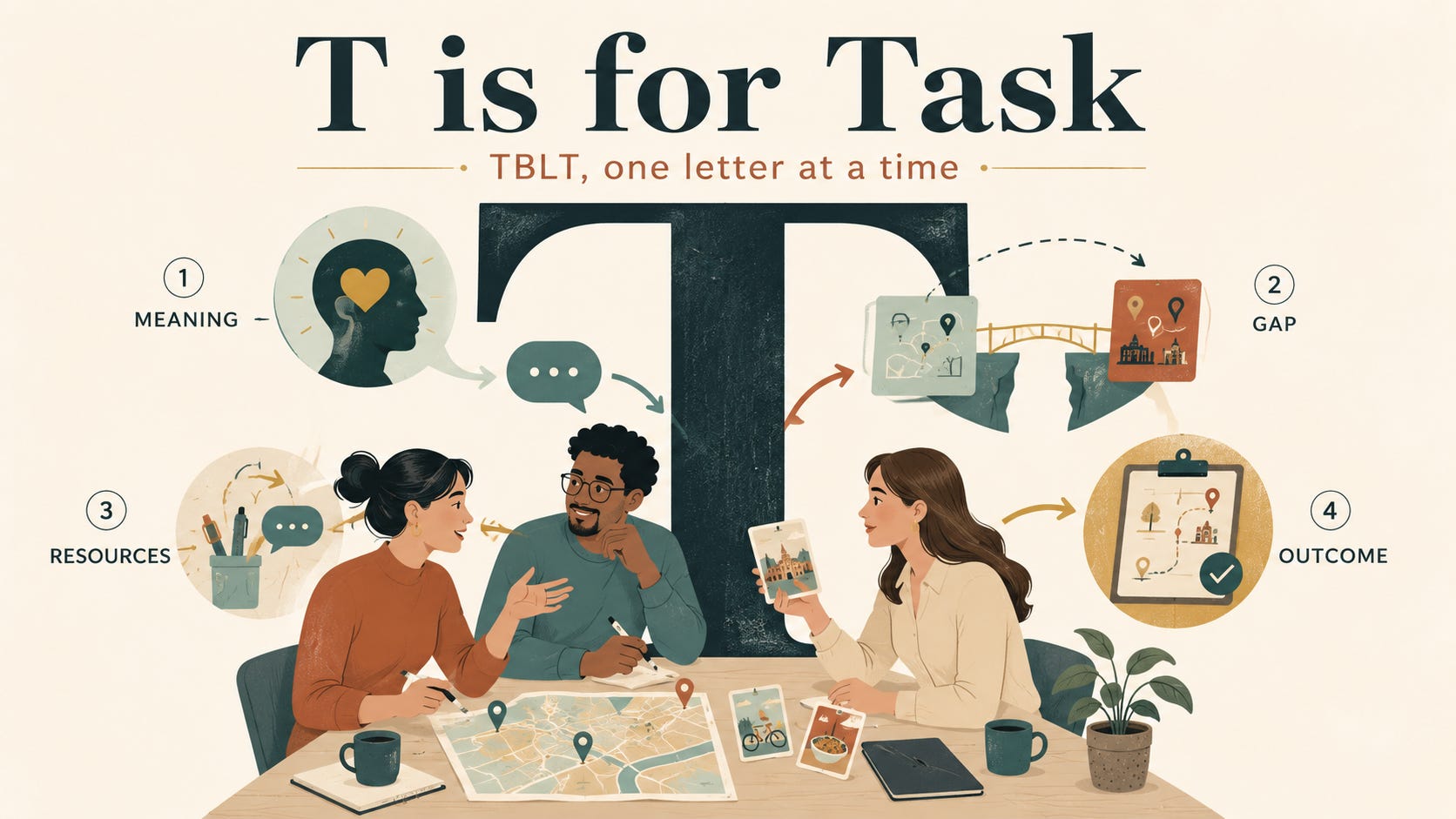
Taken together, these definitions point to 4 things a task needs to be a task.
First, a primary focus on meaning, where communication is the goal rather than the demonstration of a pre-selected structure. Second, a gap of some kind — something to find out, negotiate, decide, or resolve — that gives the interaction a genuine purpose. Third, learner use of their own linguistic resources, rather than retrieval of language that has just been presented. And finally, a non-linguistic outcome: something produced, decided, or communicated that you can point to when the task is done.
Remove any one of these, and you probably have an exercise. You might have a useful exercise. But you don’t have a task.
Here’s a concrete example of what I mean.
A teacher presents the structure I recommend / I suggest + -ing with a few model sentences. Learners then complete a controlled practice activity:
“Write 3 recommendations for a tourist visiting your city, using the target structure.”
This looks communicative. It has a real-world flavour. But notice what’s happening:
the linguistic outcome is predetermined, the form is prescribed, and the learner’s job is essentially to retrieve and reproduce something they’ve just been given. There’s no gap. There’s no genuine communicative pressure. The language has already made all the important decisions before the learner opens their mouth.
Now compare that with a task I used with a group of adult immigrants in Toronto. The setup was simple:
a friend from your home country is coming to visit for the first time. Your job is to prepare recommendations: places to go, things to eat, things to see, etc.
The outcome was a short presentation to the group, who then asked questions and pushed back on the suggestions.
I recorded a few proficient speakers doing the same task beforehand, and what I found genuinely surprised me.
Almost none of them used the structures the textbook had prepared me to teach. They said things like:
There’s this place on Queen Street you have to try …
Honestly, skip the CN Tower …
You should check out this park …
You can’t leave without going to Kensington Market.
Real recommendations don’t sound like controlled practice. They sound like someone telling you something they actually believe.
When my learners heard those recordings, something changed. Several of them said, that it was the first time English had sounded like something they might actually want to say.
That’s what a task does that an exercise doesn’t:
it creates conditions in which the learner has something genuine at stake: something to communicate, someone to communicate it to, and a reason to care whether they’re understood.
Samuda’s now-classic “things in pockets” task captures this beautifully. Learners are given a set of objects found in a mystery person’s discarded overcoat and asked to figure out, together, who the person might be: their age, their situation, their recent history, their plans.
The task cannot be completed without expressing possibility and probability, which means learners run directly into modal verbs whether the teacher has pre-taught them or not. The communicative pressure creates the linguistic need, rather than the other way around.
That, Samuda argues, is what makes a task task-essential: the design predisposes learners toward particular language because of what the task requires them to mean, not because the teacher has decided which structure comes next.
And I think the reason this distinction is so important, and the reason it’s worth spending an entire post on a single letter, is that a lot of what gets called task-based teaching in practice is actually something closer to task-decorated teaching.
Task-decorated teaching: grammar lessons with a communicative activity bolted on at the end, where the task exists to practise the structure rather than to drive the learning.
But that’s not a criticism of teachers who do this - far from it. It’s a reflection of how deeply the grammar-first logic is baked into most of the materials, training, and institutional expectations most of us have inherited.
But it’s worth calling a spade a spade here. Because if the task doesn’t require learners to communicate — if they can complete it by retrieving a pre-selected form without any genuine need to mean something — then the task is doing decoration, not instruction.
And I believe we can do better than that. Do you agree?
Next in the series: B is for Based and what it actually means for tasks to organize the learning, rather than sit on top of it.
If you’re interested in working through these ideas in practice (i.e. designing tasks, analyzing what makes them work, and building lessons that start with meaning rather than form) TBL4T opens again in September 2026.
References:
Ellis, R. (2003). Task-based language learning and teaching. Oxford University Press.
Long, M. H. (2015). Second language acquisition and task-based language teaching. Wiley-Blackwell.
Samuda, V. (2001). Guiding relationships between form and meaning during task performance: The role of the teacher. In M. Bygate, P. Skehan, & M. Swain (Eds.), Researching pedagogic tasks: Second language learning, teaching and testing (pp. 119–140). Longman.
Willis, J. (1996). A framework for task-based learning. Longman.